
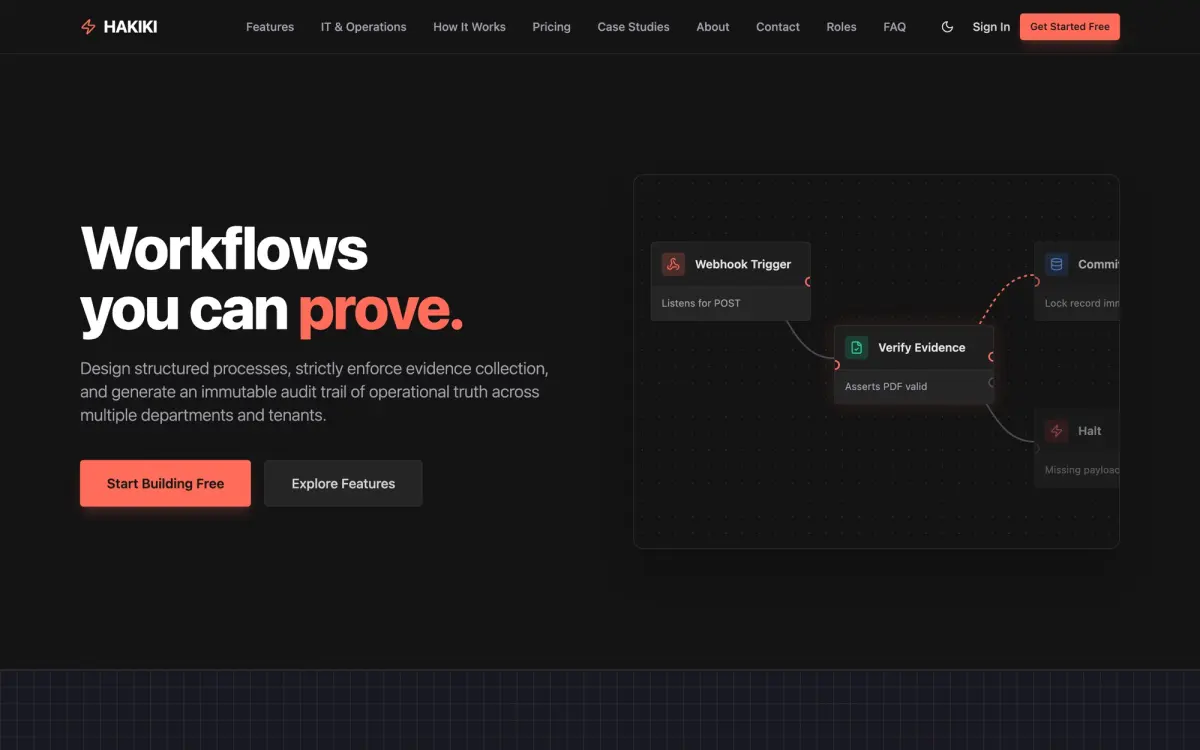
Most organisations that need real operational compliance run on WhatsApp approvals, paper sign-offs, and shared spreadsheets. None of it holds up when a regulator, insurer, or investor asks for proof. HAKIKI is the workflow platform we built to fix that — as a standalone product, not a one-off client build.
The problem
Every organisation running repeatable operational processes — safety inspections, KYC checks, delivery confirmations, patient intake — eventually needs to prove those processes actually happened. A checklist filled in from memory after the fact, or a spreadsheet anyone can edit, is not proof. It is a liability the moment someone asks for it.
Off-the-shelf checklist tools handle the simple case: tick a box, move on. They do not handle mandatory evidence — a photo, a signed document — strict step ordering, or role-based review and approval. And most are single-tenant, built for one organisation rather than a platform serving many.
We needed a workflow engine configurable for wildly different processes — a hospital's pre-surgery checklist and a courier's proof of delivery — without being rebuilt for each one.
What we built
HAKIKI is a multi-tenant workflow platform built on Spring Boot and React. Organisations author their own checklist templates from a library of step types — boolean confirmations, file uploads, text and numeric entry, single- and multi-select — and assign them to departments within their tenant.
Every execution is enforced in order: a step cannot be skipped, and evidence is captured at the point of work, not reconstructed afterward. Once an execution is complete, it is locked — timestamped, attributed to the person who did it, and immutable.
Review and approval workflows route completed executions to a supervisor, department head, or compliance officer, with an audit log and export built for the moment someone external asks for proof — a regulator, an auditor, an insurer, or a client disputing an SLA.
HAKIKI is live at gethakiki.com